“Real-time” imaging upload is not magic — it is arithmetic. Understanding the math tells you exactly how much bonded connectivity a mobile imaging vehicle actually needs.
The workload
A single mammography study is hundreds of megabytes of DICOM data. A busy clinic runs dozens of exams a day. Batch it, and radiologists wait until end of shift — hours after the patient left. Stream it as captured, and reads begin while the clinic is still working. The only variable that changes the experience is sustained upload bandwidth.
Why one link can’t do it
A single 5G link at a parking-lot location is unpredictable — it shares a tower with everyone nearby and fades as the vehicle’s position changes. Bond eight to ten independent 5G connections with SpeedFusion, though, and you aggregate their throughput into one pipe while smoothing out any single link’s dips. That is what moved these deployments from same-day batch to real-time: not a faster modem, but many modems behaving as one.
Size to sustained aggregate upload, add headroom for a bad-signal day, and remember the golden rule — every new WAN you add must be enrolled in the SpeedFusion tunnel, or it sits idle when you need it most.
If your disaster-recovery plan includes the word “failover,” you’re doing it wrong.
SpeedFusion internet bonding means increased performance, more uptime, and no failover — because the session was already riding every link.
Own your network. Peplink hardware is bought once and it lasts — it keeps bonding and routing with or without an active warranty or the cloud. No forced subscriptions, no required licenses.
Grow past a handful of sites and the old answer was MPLS: expensive private circuits, long provisioning times, and a carrier that owns your network. For a practice adding clinics faster than a carrier can trench, that model breaks.
Hub-and-spoke over the internet you already have
Each clinic gets a Peplink edge with whatever WAN is available — broadband plus cellular, or cellular alone. SpeedFusion tunnels connect every site back to a FusionHub in your data center or cloud, forming a private, encrypted overlay across ordinary internet links. You get MPLS-grade privacy and any-to-any routing without the MPLS bill or the wait.
Day-one connectivity at a new clinic on cellular, before wired is even ordered.
One pane of glass — InControl 2 manages every site, so a template rolls out identically to clinic number 3 or clinic number 30.
Uptime by design — each site bonds its links, so a broadband outage is a non-event, not a closed clinic.
The result is a network that scales at the speed you open doors — not the speed a carrier can dispatch a truck.
If your disaster-recovery plan includes the word “failover,” you’re doing it wrong.
SpeedFusion internet bonding means increased performance, more uptime, and no failover — because the session was already riding every link.
Own your network. Peplink hardware is bought once and it lasts — it keeps bonding and routing with or without an active warranty or the cloud. No forced subscriptions, no required licenses.
When a clinic sends imaging or records from a vehicle or a pop-up site back to the data center, that data crosses networks you do not own — cellular carriers, satellite, the public internet. HIPAA expects that traffic to be protected in transit. The good news: the same technology that makes the connection reliable also encrypts it.
Encryption is not a bolt-on
A SpeedFusion tunnel is an encrypted VPN by design. Traffic is split across multiple links at the packet level and reassembled at a Peplink endpoint or FusionHub inside your network — so PHI is both bonded and AES-encrypted end to end, without a separate VPN client on every device.
A stable identity for roaming devices
Because clinical devices ride the tunnel, they present a single, stable virtual IP no matter which physical link is carrying them at that instant. That keeps sessions to your PACS or EHR alive as the vehicle moves between coverage zones — and it keeps your firewall rules simple, because everything arrives from one known tunnel endpoint.
Segment further with VLANs — clinical, guest, and device networks kept apart on the same hardware — and you have a mobile site that is both compliant and genuinely hard to knock offline.
If your disaster-recovery plan includes the word “failover,” you’re doing it wrong.
SpeedFusion internet bonding means increased performance, more uptime, and no failover — because the session was already riding every link.
Own your network. Peplink hardware is bought once and it lasts — it keeps bonding and routing with or without an active warranty or the cloud. No forced subscriptions, no required licenses.
For years the standard way to get cellular into a medical vehicle was a router in a cabinet and long coaxial cables running to antennas on the roof. It worked — badly. Every foot of LMR coax between the modem and the antenna throws away signal.
The hidden tax of coax
A 15-to-30-foot coax run introduces real RF loss on every modem — loss that compounds across a vehicle full of them. It also demands weatherproofing, careful routing, and RF know-how at every install, in a vehicle that vibrates and flexes down the highway. Your expensive 5G modem never gets to run at its potential.
Move the modem, not the signal
The modern design puts a standalone Peplink BR1 Pro 5G inside the roof antenna, inches from the elements. RF loss goes to zero. Each unit connects back to the core router with a single Cat6a ethernet run — no coax, no RF specialist — and the router bonds them all with SpeedFusion.
Every modem runs at full potential throughput.
One cable type: ethernet. Installs get simpler and cheaper.
Scale by adding another antenna-modem — not by re-planning coax.
It is a small architectural change with an outsized result: more usable bandwidth, cleaner builds, and a template you can replicate across a whole fleet.
If your disaster-recovery plan includes the word “failover,” you’re doing it wrong.
SpeedFusion internet bonding means increased performance, more uptime, and no failover — because the session was already riding every link.
Own your network. Peplink hardware is bought once and it lasts — it keeps bonding and routing with or without an active warranty or the cloud. No forced subscriptions, no required licenses.
Mobile mammography brings life-saving screening to communities without a fixed imaging center — from a vehicle that parks somewhere different every day. The catch: each study is hundreds of megabytes of DICOM data, radiologists need it fast, and there is no broadband, no reliable Wi-Fi, and no RF expert on site.
West Networks has served many mobile mammography clinics, and refined the connectivity across three generations of Peplink hardware.
Three generations
Gen 1 — EPX + 12 bonded 4G modems. SpeedFusion aggregated all twelve into one tunnel — enough to upload a full day’s studies by end of shift. Still batch, and long LMR coax runs bled RF signal.
Gen 2 — 10 bonded 5G modems. Fewer links, far more throughput. The bond crossed the threshold for real-time upload — radiologists could read studies while the clinic was still seeing patients.
Gen 3 — Balance 580X + 8–10 BR1 Pro 5G in MAX Antennas. Each 5G modem now sits inside the roof antenna, inches from the elements: zero RF signal loss. A single Cat6a run replaces coax; the switch presents each BR1 Pro as a WAN via VLAN trunking; SpeedFusion bonds them all.
The outcome
Real-time DICOM upload as images are captured. Zero RF loss. No coax, no RF specialist at each site, PoE++ power from the 580X, and a standardized build that replicates across a fleet. In screening, time-to-results is patient care — and this architecture moves results hours, sometimes a full day, sooner.
If your disaster-recovery plan includes the word “failover,” you’re doing it wrong.
SpeedFusion internet bonding means increased performance, more uptime, and no failover — because the session was already riding every link.
Own your network. Peplink hardware is bought once and it lasts — it keeps bonding and routing with or without an active warranty or the cloud. No forced subscriptions, no required licenses.
Telehealth has a trust budget, and every frozen frame spends it. Patients forgive one glitch. Clinicians don’t forgive many more — and a clinician who stops trusting the link stops offering the visit type. If you run a mobile clinic or a rural telehealth program, connectivity isn’t an IT line item; it’s the adoption ceiling of your whole service line.
What a drop actually costs
Start with the direct number: a completed video visit bills roughly $200+ for many common codes. A visit that drops mid-consult usually reschedules — and rescheduled visits inherit the no-show problem, which commonly runs 15–30% in outpatient settings. So one drop isn’t one delayed visit; it’s a $200+ reimbursement at risk plus a meaningful chance the patient never comes back for that encounter at all.
Now scale it. A clinician doing 10 video visits a day who loses two visits a week to connectivity is leaking $20,800+ per year — per clinician. A mobile clinic with three clinicians on video is leaking the cost of its entire connectivity stack every few weeks. And that’s before the softer costs: patient satisfaction scores, clinician frustration, and the coordinator hours spent rebooking.
The uncomfortable part: most of those drops aren’t outages. They’re five-second carrier hiccups — a congested cell, a handoff, a fade — that a spreadsheet-shaped workload would never notice but a live video session cannot survive.
Why video is the least forgiving workload
EHR access, e-prescribing, and eligibility checks are transactional: a retry is invisible. Video is a continuous real-time stream: there is no retry, only a freeze. Loss of even 2–3% of packets for a few seconds degrades a consult; a carrier switch on a failover router (5–20 seconds of teardown and re-dial) ends one.
That’s why the fix for telehealth is specifically bonding with WAN smoothing, not failover:
WAN smoothing duplicates the video stream’s packets across both carriers. If Carrier A drops a burst of packets, the identical packets already arrived via Carrier B. The consult doesn’t freeze, because from the application’s point of view nothing happened.
Hot failover covers the bigger case: if Carrier A dies entirely, the session continues on Carrier B with zero teardown — the video call, the EHR session, the e-prescribing token all stay alive.
The clinician experience changes from “I hope the connection holds” to simply not thinking about it. That’s when adoption climbs.
The PHI half of the story
Every packet of that consult is PHI, and HIPAA’s Security Rule (45 CFR §164.312(e)) requires transmission security for ePHI. Here’s the clean way to think about it:
The SpeedFusion tunnel encrypts all traffic — video, EHR, e-prescribing, eligibility — with 256-bit AES from the clinic (or van) to your data center or cloud hub, regardless of which carrier, satellite, or wire the packets crossed.
That gives your security risk analysis a simple, defensible answer for the transmission-security control: everything in transit is inside an AES-256 tunnel, on top of whatever TLS the applications already do.
The educator’s honest caveat, always: technology supports compliance; it doesn’t grant it. Your covered entity still owns the risk analysis, BAAs, access policies, and training. What bonded, encrypted transport does is remove the “we’re piping PHI over the host site’s guest Wi-Fi” finding from your audit.
One more operational win: because the mobile clinic carries its own encrypted uplink, you never have to negotiate network access with a host location — a church parking lot, a school, an employer. Their network is not in your PHI path at all.
The math and the deployment
Kit cost for a mobile clinic or rural site: roughly $1,000–$2,000 one-time, owned, plus two SIMs (~$80–120/month) and SpeedFusion service (~$25–40/month). Total recurring around $120–160/month for two bonded carriers.
Against the old way: a rural wired circuit means a $5,000–$50,000 construction quote, a 60–120 day wait, and at the end of it — one path, one backhoe away from an outage that costs a 4-provider clinic $1,800–$4,000 per hour. The bonded kit deploys the day it arrives, and if fiber ever does show up, it just becomes one more bonded path.
Payback in visits: at $200+ per saved visit, the entire monthly cost is covered by one consult that didn’t drop. Everything after that is margin — and trust.
A mobile mammography coach is a radiology department on wheels — right up until the last step. The imaging is state of the art. The data path home usually isn’t.
The size of the problem, in gigabytes
A 2D screening mammogram is a few hundred megabytes. A 3D digital breast tomosynthesis (DBT) study runs roughly 1–3 GB per patient. A well-run coach screens 30–40 patients a day. Do the multiplication: a single coach generates 40–100+ GB of DICOM data every screening day, and every gigabyte of it is PHI that has to move encrypted.
Now look at how most programs move it today. Option one: don’t. Store studies on the coach, drive them back to the reading center at night, and ingest them there — the sneakernet. Reads happen 24–48 hours after the patient went home. Callbacks take another cycle. Option two: beg the host site for network access. Employer guest Wi-Fi is slow, shared, and — reasonably — often refused outright by host IT, because “please put 60 GB of medical data through our guest VLAN” is a hard ask. Option three: a single-carrier hotspot or router, which in a metal coach at the far corner of a parking lot delivers a fraction of its rated speed and dies completely at rural stops.
Every one of those options has the same failure mode: the program’s clinical turnaround time is hostage to a data-transport afterthought.
Why turnaround time is a business metric, not just a clinical one
Mobile imaging programs live and die on host-site relationships. Employers and rural hospitals book coaches because screening on-site raises participation — and they renew based on experience. Same-day reads mean same-day or next-day callbacks, which host HR teams and rural clinical partners notice. A program that ships results in 48–72 hours is competing against fixed centers that report same-day. Turnaround time shows up in renewal rates, and a recurring host-site contract is typically a six-figure relationship.
There’s also radiologist economics: a reading group that gets studies in a nightly 80 GB lump reads in a lump. Studies that trickle in all day keep the worklist flowing and the radiologists productive.
The New Enterprise version of an imaging coach
The fix is not “find better Wi-Fi.” It’s making the coach carry its own enterprise-grade uplink, built from every path available in that parking lot.
A Peplink MAX HD2 (dual cellular modems) or MAX Transit Pro bonds two to four carriers at once through SpeedFusion. Bonding — not failover — means the upload uses the combined upstream of every path. Where one carrier gives you 15 Mbps up from that parking lot, three carriers bonded might give you 40–50 Mbps. Add a flat-mount Starlink for rural stops and you’ve added another 10–40 Mbps of upstream that doesn’t care about cell towers at all. This is the same engine ocean vessels use to bond 4–20 Starlinks mid-Atlantic; a hospital parking lot is an easy day for it.
At 40 Mbps bonded upstream, a 2 GB tomo study moves in about 7 minutes. Studies upload while the next patient is being positioned, and the day’s last study lands at the reading center before the coach leaves the lot.
Three details matter for imaging specifically:
Hot failover mid-transfer. A carrier fade during a 2 GB DICOM push doesn’t reset the transfer — packets shift to the other paths and the TCP session never notices. With single-carrier, that same fade restarts the study from zero.
Encryption without host-site dependence. The SpeedFusion tunnel is 256-bit AES from coach to PACS ingest — you never ask host IT for anything, and their network never touches your PHI path. (Compliance caveat as always: the tunnel supports your HIPAA transmission-security control; your program delivers compliance.)
External antennas. Coaches are Faraday cages parked in RF-hostile corners. Roof-mounted MIMO antennas routinely double usable cellular throughput versus an inside-the-coach hotspot.
The math
Kit cost: roughly $3,000–$5,000 one-time per coach, owned, plus SIMs (2–4 × $40–60/month) and SpeedFusion service. Call it ~$5,000 year one, ~$2,500/year after.
Against that: reads move from 24–48 hours to same-day; callbacks move from day 3 to day 1; the nightly drive-and-ingest labor disappears; and the host-site renewal conversation starts with “results before your employees left the building.” One protected six-figure host contract funds the entire fleet’s connectivity for years.
Every ambulance in your fleet probably already has a cellular router. That decision was right. The decision that came with it — one SIM, one carrier — is the one quietly costing you.
One SIM is one coverage map
Put a single-carrier router in a rig and your connectivity is exactly that carrier’s coverage map: no better, no worse. Every EMS crew can name the spots on their routes where the tablet spins — the river valley on Route 9, the industrial corridor, the last four miles to the county line. Those aren’t random. They’re the holes in one carrier’s map, and they’re in the same place every shift.
Here’s what makes this a clinical problem instead of an IT annoyance. The workloads riding on that link have gotten heavier and more time-critical: ePCR sync, CAD and AVL, video consults with med control, and — most critically — 12-lead ECG transmission to the emergency department. Pre-hospital ECG transmission is one of the few levers EMS controls in the door-to-balloon chain. The national target is 90 minutes from door to balloon for STEMI patients, and early cath lab activation from a field-transmitted ECG is how systems beat it. When the transmission fails in a dead zone, the cath lab activates late. That’s not a dropped packet; that’s myocardium.
Failover isn’t the answer either
The first upgrade most fleets consider is a dual-SIM router with failover: if Carrier A dies, switch to Carrier B. Better than nothing — and still not good enough, for one specific reason: failover is a switch, and switches drop sessions. The router detects the outage (seconds), tears down, re-establishes on the second carrier (more seconds), and every live session — the med-control video call, the VPN to the hospital, the ECG transmission in flight — dies and has to restart. In a moving ambulance passing through a coverage seam, that can happen four times in ten minutes.
What bonding actually does
Bonding is a different mechanism. A Peplink MAX Transit 5G with SpeedFusion runs two or more carriers simultaneously and wraps them in a single encrypted tunnel. The hospital end sees one connection. Underneath, packets flow across every available path. When Carrier A fades, traffic is already flowing on Carrier B — there is no switch, no teardown, no session drop. SpeedFusion’s WAN smoothing goes further for video: it duplicates critical packets across paths, so a burst of loss on one carrier is invisible to the med-control consult.
Two side benefits matter to EMS specifically. First, the tunnel is encrypted with 256-bit AES end to end, which supports the HIPAA transmission-security requirement for the PHI riding inside — ePCR data, ECGs, video. (The honest caveat we always give: technology supports compliance; your agency’s program delivers it.) Second, the same tunnel carries GPS/AVL, so fleet tracking rides the unbreakable link too.
The math, per response
Let’s do the numbers for a 40-ambulance county fleet.
Added recurring cost: a second data SIM (~$40–60/month) plus SpeedFusion service (~$25/month). Call it $75/month per rig — $3,000/month, $36,000/year fleet-wide.
Hardware: MAX Transit 5G class units run roughly $1,500–$2,000 per rig one-time. You own them; no venue premiums, no construction, no carrier contract lock.
Denominator: a 40-rig county system typically runs 40,000+ responses a year.
$36,000 across 40,000 responses is 90 cents per response to make ECG transmission, ePCR, and med-control video survive every dead zone on every route. Compare that with the cost side of a single failed STEMI transmission — clinically, legally, and in the QA review — and the decision stops being about money.
Deployment is measured in hours per rig: mount, roof antenna, power, two SIMs, InControl profile push. And at the depot, a SIM Injector keeps the SIM cards physically in the equipment room and serves them to rigs over the network — so when you renegotiate carriers next year, nobody spends a week climbing into ambulances.
The takeaway
Single-SIM LTE in an ambulance was the right call in 2018. In 2026, the workloads are clinical, the dead zones are known, and the fix costs less than a dollar a response. Stop building around one carrier’s map. Start bonding.
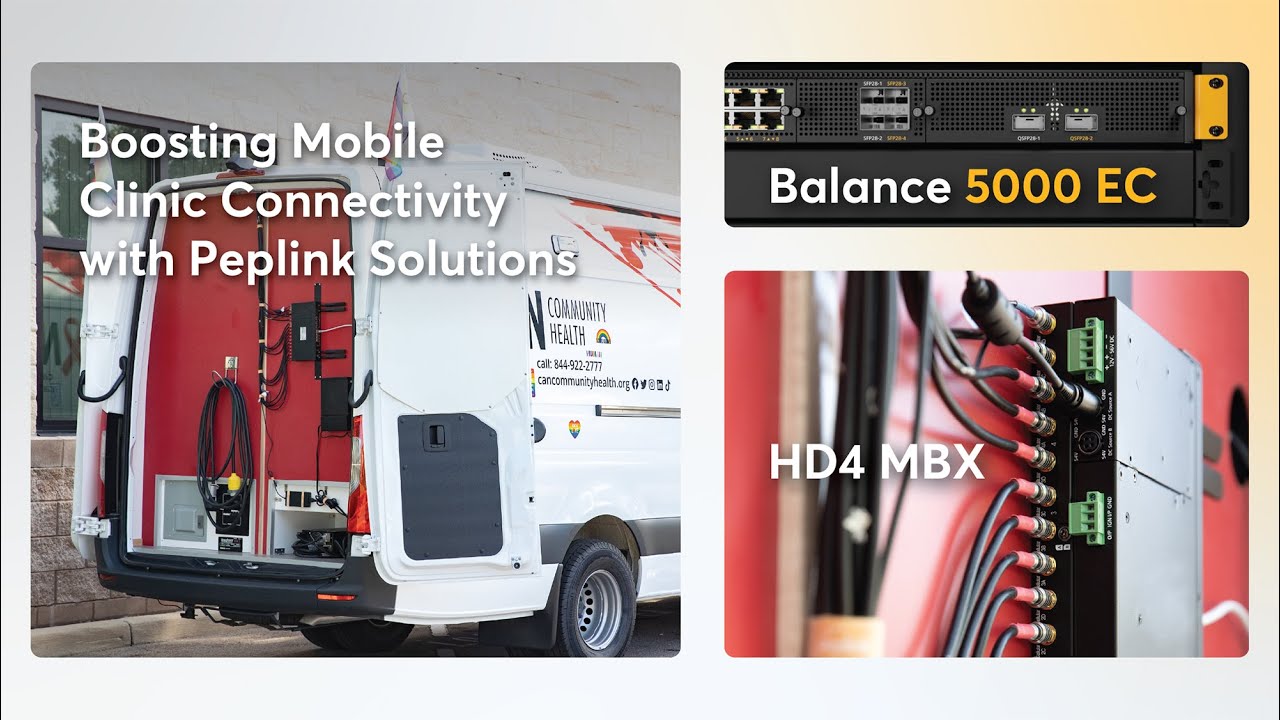
magine transforming the network infrastructure of 27 clinics across the U.S. in mere days—zero downtime, seamless scalability, and a performance boost that keeps healthcare running smoothly. Sounds like a tech fairy tale, right? Well, that’s exactly what Peplink achieved for Can Community Health, a lifeline for underserved communities, and it’s a story worth diving into.
Watch: How Peplink Transformed 27 Clinics in Just Days · Peplink University
How Peplink Turned 27 Clinics into Connectivity Powerhouses in Just Days
Imagine transforming the network infrastructure of 27 clinics across the U.S. in mere days—zero downtime, seamless scalability, and a performance boost that keeps healthcare running smoothly. Sounds like a tech fairy tale, right? Well, that’s exactly what Peplink achieved for Can Community Health, a lifeline for underserved communities, and it’s a story worth diving into.
In a recent Peplink University webinar, we got the inside scoop on how Peplink’s cutting-edge networking solutions revolutionized 27 clinics, enhancing everything from patient services to telehealth capabilities. Spoiler alert: it’s a masterclass in reliability, innovation, and getting things done fast. Let’s break it down.
A Seven-Year Journey to Unbreakable Connectivity
Can Community Health had a problem: unreliable ISPs were dragging down their VoIP systems and network performance across 27 clinics. Enter Peplink. What started as a quest for "unbreakable VoIP" seven years ago turned into a full-blown transformation. Peplink didn’t just patch a hole—they rebuilt the foundation.
The journey kicked off with a test run of the Balance 380 at the Tuttle location. After a month and a half of tinkering, the team knew they’d struck gold. Peplink’s ecosystem—routers, switches, and SpeedFusion tech—consolidated systems, boosted control, and delivered rock-solid connectivity. The result? A network that could handle 27 clinics like a champ, all managed with precision.
Zero Downtime, Maximum Impact
Here’s where it gets impressive: Peplink pulled off this transformation with zero downtime . Using a non-intrusive pilot, they integrated routers alongside existing setups, scaling up without a hitch. IPSEC tunnels laid the groundwork, and an upgrade to SpeedFusion took it to the next level—think faster, more reliable connections that don’t flinch under pressure.
In Florida, the team preconfigured 27 routers in Virginia, shipped them to Miami and beyond, and had clinics up and running in record time. Tags and automation made global configuration a breeze, proving that Peplink’s feature-rich platform isn’t just powerful—it’s efficient.
Mobile Medicine Meets Instant Connectivity
For Can Community Health, mobility matters. Peplink delivered portable solutions for mobile medical units, letting clinics hit the ground running without waiting for ISP installs. Picture this: SDX routers with dual 5G and triple 4G modules powering up 35 clinics (yep, they scaled beyond the initial 27!), backed by 10-gig ports and fiber redundancy. It’s a routing aggregation system that screams resilience.
And the cost? Peplink’s approach slashed complexity and expenses, offering cloud-centric clinics a scalable, high-performing lifeline. Whether it’s a mobile unit or a brick-and-mortar site, Peplink’s design keeps the wheels turning.
Seven Years of Compliance and Consistency
Fast forward seven years, and Peplink’s still holding strong. With minimal downtime (just one router hiccup from an electrical event), predictable costs, and compliance locked in, leadership’s all-in—no pushback here. The data center’s upgrade to the 5000 series with 100-gigabit interfaces and SpeedFusion VPN has only sweetened the deal, juicing up connectivity speeds and performance with every firmware tweak.
Telehealth Takes Flight with HD4 MVX 5G
Telehealth’s a game-changer, but it demands bandwidth and reliability. Peplink answered with the HD4 MVX 5G router, standardizing it across a nationwide mobile fleet. Remote areas? No problem. Video visits? Crystal clear. Port switches added flexibility, letting clinics swap locations without compatibility headaches. It’s connectivity that bends without breaking.
Starlink and Beyond: The Future of Flexibility
Peplink’s versatility doesn’t stop at clinics. They’ve even teamed up with Starlink for maritime applications and resilient backups, bonding it with cellular networks for stability that doesn’t compromise throughput. Packet loss and latency? Handled. It’s a consistent UI across mobile and stationary setups—proof that Peplink’s built for the real world.
The Takeaway: Peplink Delivers
From preconfigured routers to 2.5 Gbps uplinks hitting 600 Mbps in testing, Peplink’s platform is a powerhouse. It’s easy to deploy, high-performing, and backed by responsive support. Even in high-security environments, it shines—just ask the team who went from doubting certain switches to planning a massive upgrade after seeing them in action.
For Can Community Health, Peplink didn’t just solve a problem; it redefined what’s possible. Twenty-seven clinics transformed in days, seven years of reliability, and a future-proof network that’s ready for anything—telehealth, mobile units, or beyond. If you’re eyeing a connectivity upgrade, Peplink’s worth a look. After all, who wouldn’t want a network that works this hard—and this fast?
Related
Comments are closed.
Originally presented on Peplink University with Professor P. Now part of the Connectivity 101 library.